Saturday, June 9, 2012

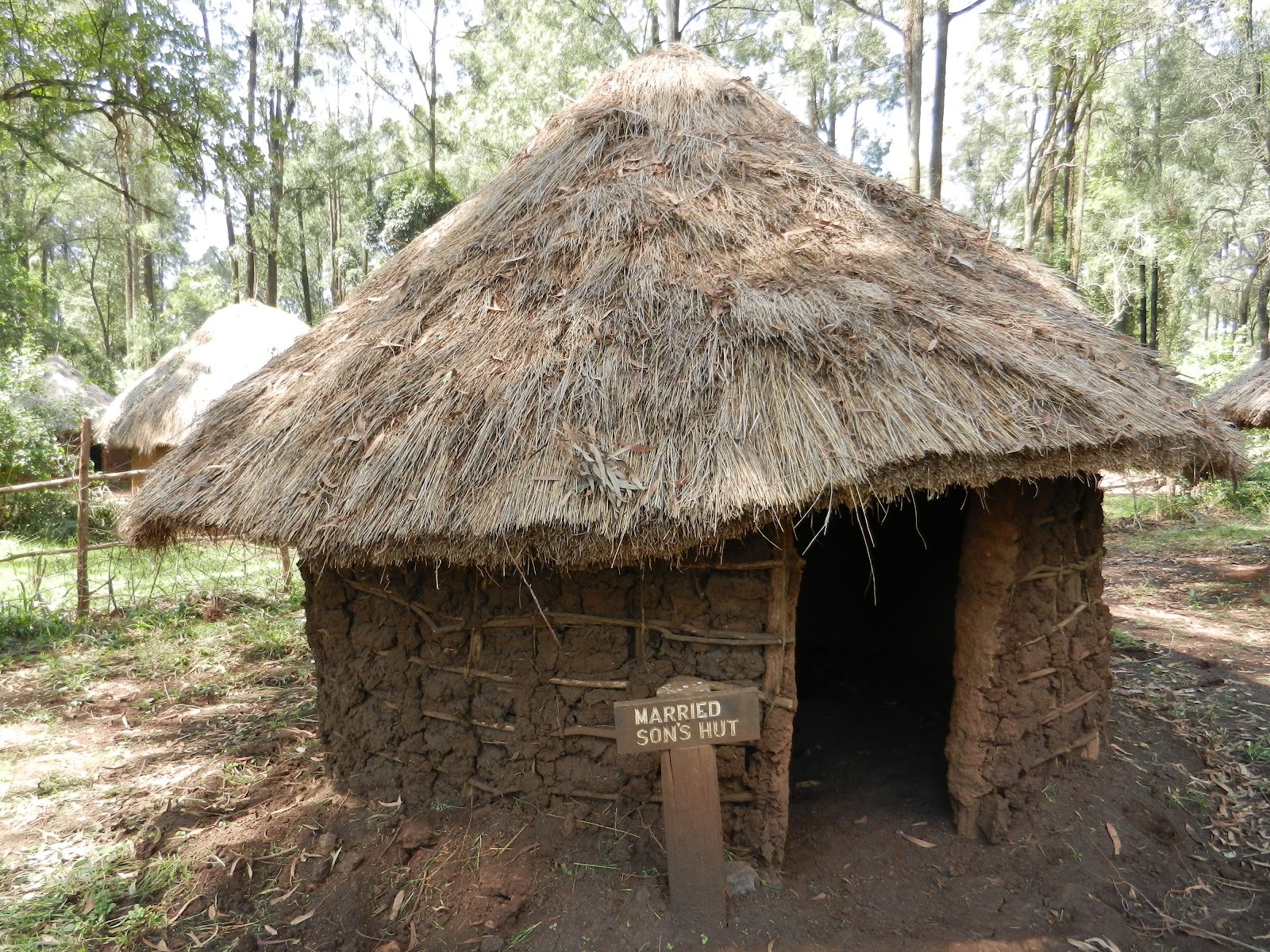
At Bomas of Kenya they have built replicas of different tribal homes.  This is the 1st wife's hut.  It is always the biggest and nicest of any of the wive's huts.
This is inside the 1st wife's house.  Behind the grass wall is the bedroom and the bed is built up on stilts.  It would be interesting to see the houses would be furnished.
This is the guest house/kitchen.  It's small but it works.
Here is Grandpa by the boys' hut.
I'm not sure what room this was but there was an empty pop bottle in is so it must be the dining room.
These are the husbands standing in front of the husband's house.  This is a different village with a little different style of house. 
It is incredible the way these huts are built using sticks, grasses and mud.  The mud is mixed with cow dung and spread over the sticks.  They are nice and cool inside.
This is another village...the houses are a little different.
These two men were there to represent the Masai tribe.  They agreed to have their picture taken with them for a few shillings.  That is a Masai necklace I am wearing...smart, eh?
Elder & Sister Hall are negotiating with the Masai.  The young men in the background were from a school.
These houses look like igloos, don't you think?
This is a close-up view of the inside of the house.   Amazing.
These women were mixing the dung and mud to spread on the huts.  Building the houses, taking care of the gardens and the children are the reseonsibilities of the women,  The men provide the property and protect the family.
These women are spreading the mud over the outside of the house so that it is nice and smooth.  The mixture makes for good insulation.
Livestock is very very important to the people in the villages.  You see herders everywhere taking care of their animals.  Even along the highways you will see animals grazing.  More than once we have had to slow down for a cow who is walking across the highway.   Many tribes still require a dowry of animals.

Tuesday, May 15, 2012

The little family who lives behind us have planted their new crops -- the rains came and it seems like overnight they have sprung up!
The mama is cooking breakfast over a fire.  You should see her scrubbing her little children.
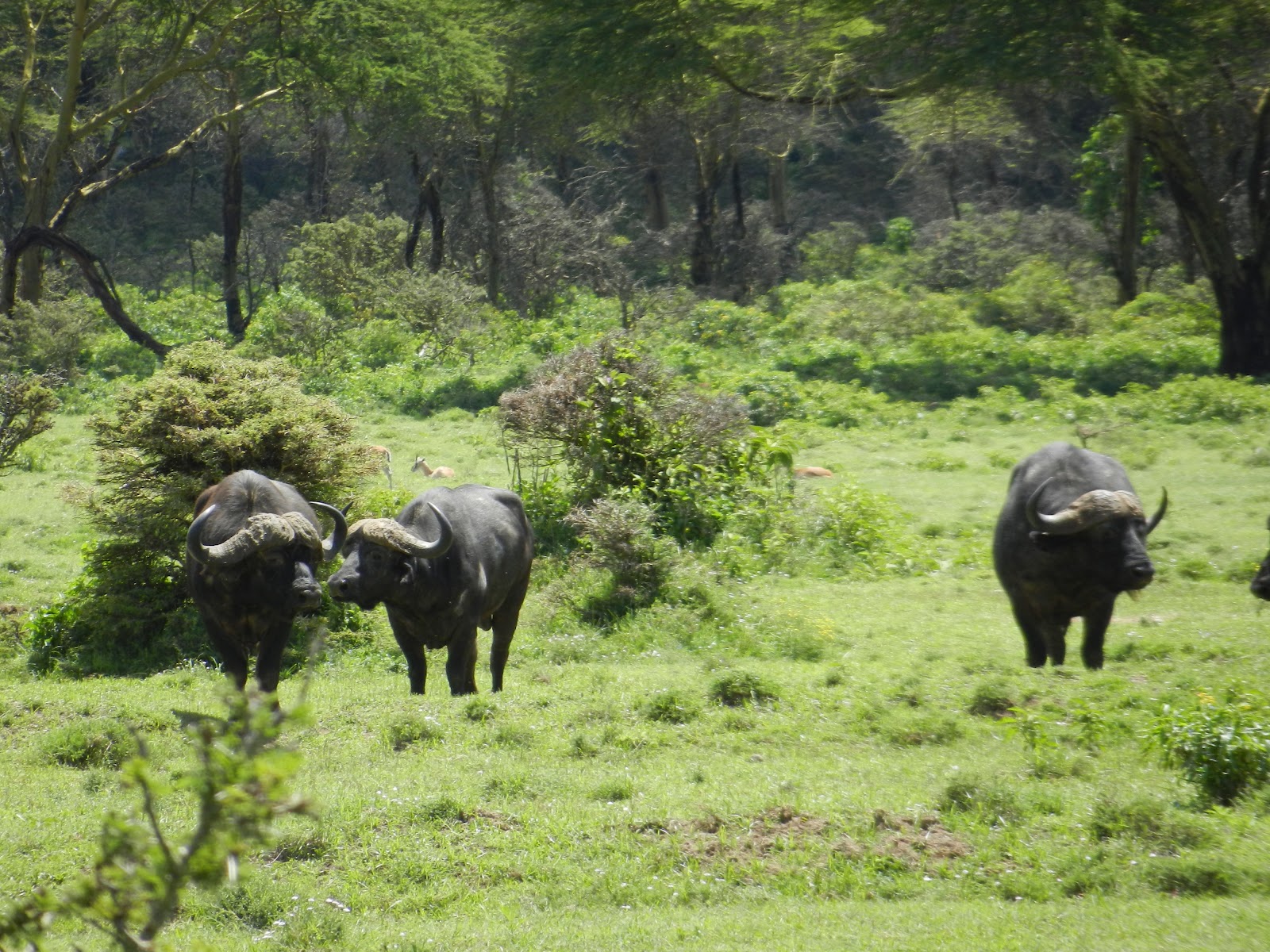
These water buffalo were on the side of the road in Naivasha.  There is much wildlife there.
Well, here's a good rear-end shot of some zebras!  Who's taking these pictures, anyway?  Gazelles in the distance.
Warthogs are funny little creatures -- they run everywhere they go.
They say water buffalo are very mean and aggressive but these guys were so busy eating, they didnt pay attention to us.  You can see how green everything is -- thanks to the rainy season.
These cactus plants grow very thick and tall and people use them for fences.  After a while they cut the cactus down and when it dries, they collect it for fire wood.
This is Naivasha Lake and there were thousands of flamingos there.  It was a beautiful sight.
Farmers were bringing their cattle and donkeys to the lake for a drink.
This was a National Geographic experience.  You would have all loved it -- especially Cami - our little Flamingo girl.

There was a photographer taking pictures with a lens as big around as a pizza pan and as long as your arm.  Click, click, click -- as fast as he could go.
There were few people on this side of the lake.  Lots of people ride bicycles or ride in carts drawn by donkeys.  There are very few vehicles.  Naivasha is famous for growing flowers which are exported all over the world.  The people who work at the flower farms are provided with humble housing, medical care and schools for their children which is a great blessing.
Elder Holmes, Elder Jensen, Elder Kakaire, Elder Hall, Elder Olsen, Sister Holmes, Sister Hall & Sylvester.
I wish you all could have been there with us!
This little monkey was looking for something to eat.
These wildebeests were grazing in a beautiful meadow.
These gazelles were mixed  in with all the other animals.  Beautiful & graceful.
These children had gathered up big bundles of fire wood and were carrying them back up a long dirt road that we had gone down to watch the animals.  Elder Holmes stopped and gave them a ride.
It's hard to guess how old these children were, but they weren't very big.
It's amazing how much weight people can carry on their heads.
Quite a talent to balance this heavy load.  I think they've done it many times before and will do it many times after.
This little girl didn't have anything to put on her head so Elder Olsen gave her his handkerchief to use as a pad.
And away they go!
This is Elder & Sister Holmes in front of their house in Naivasha.
And this is where the Elders live -- right next door to the Holmes.  It's called the "Rainbow" house because every room is painted a different -- bright color like purple, orange, yellow, blue, etc.   The Elders are so happy to have the Holmes living next door.  Not only are they the nicest people in the world, but Sister Holmes is a very good cook!
These are the power lines that lead into our apartment complex.  Maybe this has something to do with our power going out on a regular basis!?!
There are some beautiful buildings and landscaping that we pass on our way to the center.
There goes Elder Olsen with his lunch bag and umbrella -- anxious to get to work!  This is about 7:30 a.m.
These are the power lines leading into the center.  Yes, they are leaning.  There is a back-up generator that kicks on regularly.  See the sign above the building that says "Citi"  That is the landmark for our address:
Upper Hill Road Next to Citigroup
Nairobi, Kenya
There are wonderful gradeners who do fun things with the landscaping at the center.
There he is -- ready to launch forth on another exciting day in Kenya!  This is a busy place.  There is the mission office, a distribution center, many offices, a chapel with a small gym, an institute classroom and three garages.   The mission office is at the lower left-corner of the building and that's where we work.
This is one of the landscapers and he trims all the bushes by hand!